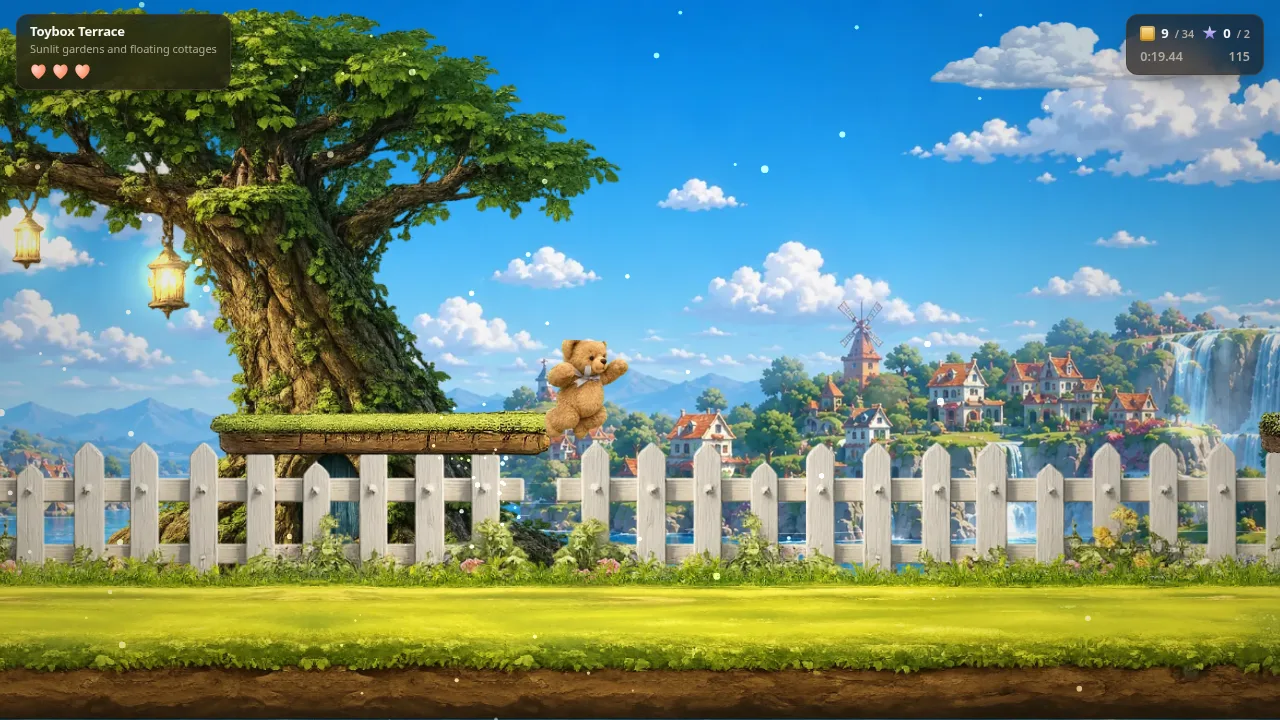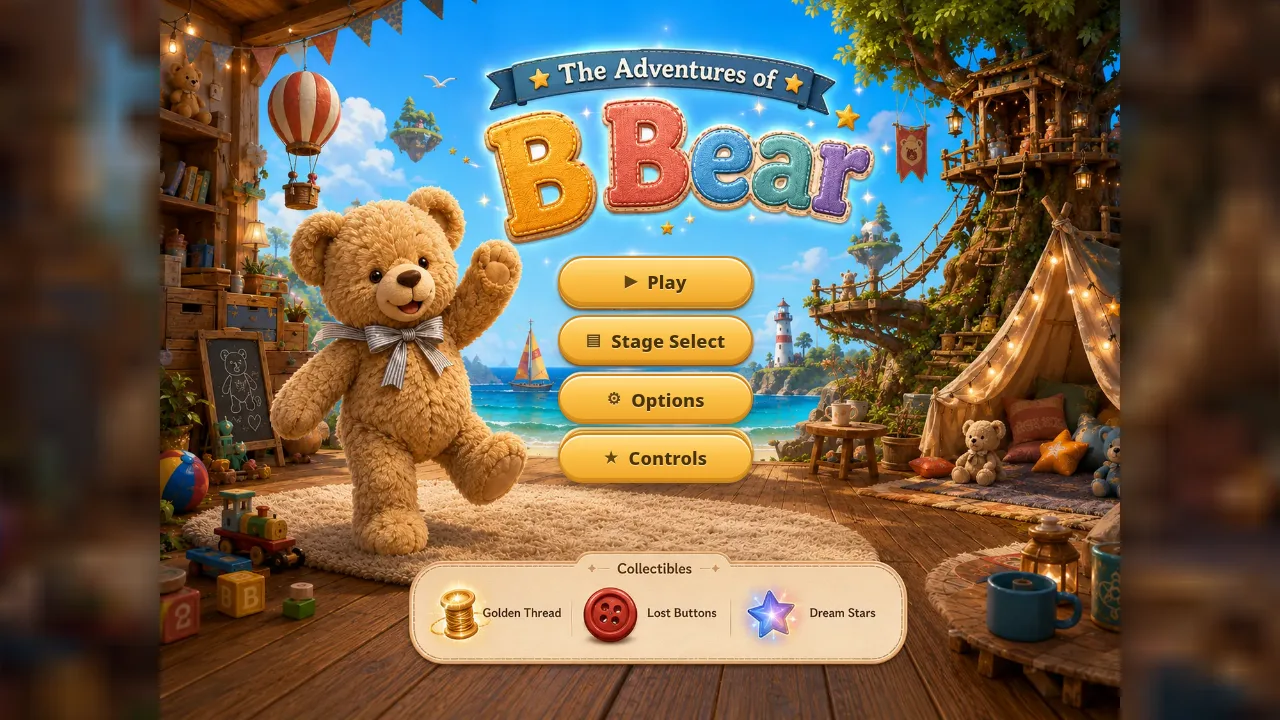
There is a particular face a child makes when their own teddy, the actual one, with the flat patch on its back where it gets slept on, walks onto a screen and jumps. It is not the face they make at any bought game, because no bought game contains their bear.
We know because we build these. The Adventures of B Bear started as photographs of one very loved teddy, and became a hand-painted platformer where he sets out across toybox worlds populated by the rest of the toy basket. This is a guide to how that happens, what it costs, and which children it lands hardest for.
Why the teddy, specifically
You could commission a game starring the child themselves, and some families do. But for younger children the teddy is usually the stronger hero, for a reason any parent will recognise.
A small child watching themselves on screen is self-conscious. A small child watching their teddy on screen is purely delighted, because the teddy is already the hero of the household's ongoing story. It has a voice someone does, opinions someone invents, a seat at meals. The game does not have to establish the character. Your family has spent years doing that.
Which is also why the painting has to be of the actual toy. Not a generic bear: their bear, with the wonky ear and the faded ribbon. Children are the world's fiercest continuity inspectors, and the moment of recognition is the entire point.
What the game actually is
The natural format is a storybook platformer: run, jump, collect, rescue. Gentle enough for small hands, familiar enough that no one needs a tutorial.
From the brief and the photographs, a build takes shape something like this:
The hero. The teddy, hand-painted from your photos, animated to walk, jump and celebrate. Character sheets come to you for approval before anything is built, so if the ear is not wonky enough, it gets wonkier.
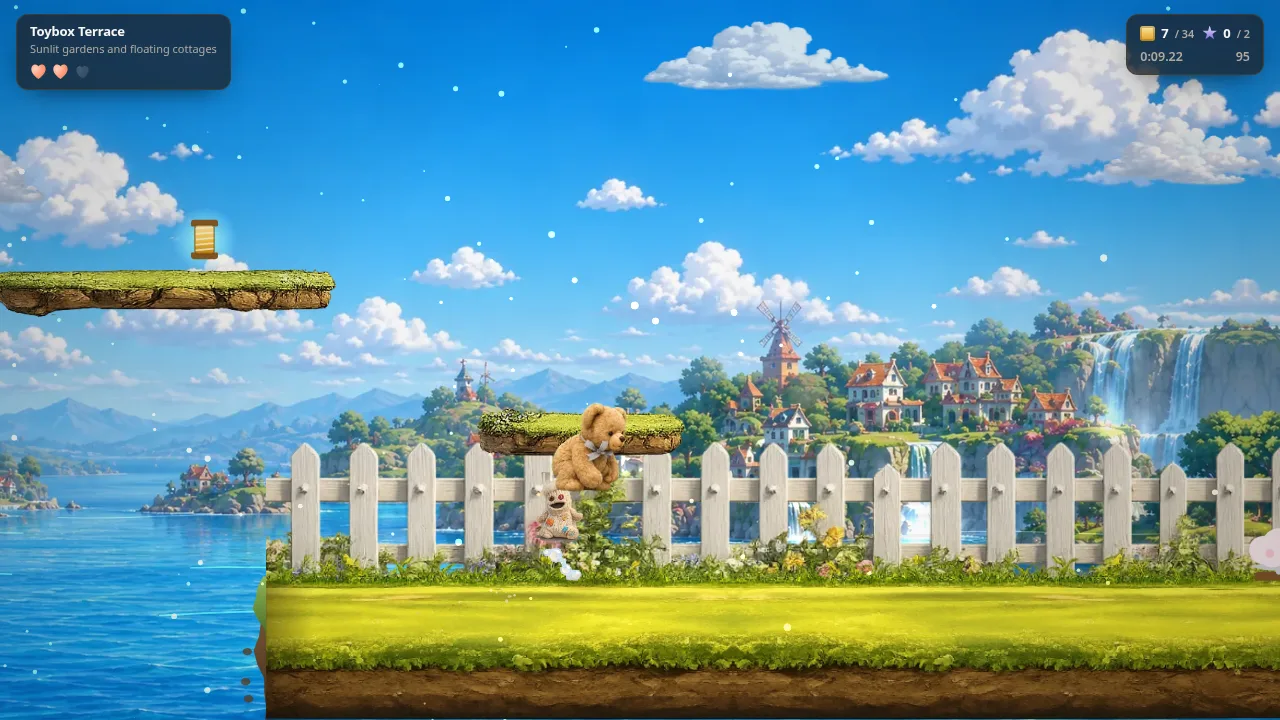
The world. Toybox terraces, bedroom-floor mountains, sock-drawer caves. The worlds are painted to feel like the child's own territory at toy scale, and details from the brief go in: the pattern of the actual curtains, the real cat asleep on the landing as a hazard.
The cast. The other toys. The dinosaur becomes the rival. The doll runs the shop. At the 1-Bit tier up to three cameos come along; at 8-Bit, up to twelve, which in most households is the entire toy basket plus a sibling or two painted in as themselves.
The quest. Something from your world. The lost blanket. The biscuit stolen by the seagull on holiday. The best quests are already family legends before we ever hear them.
The music. An original score, written for the build. At the top tier it changes character between worlds; even at the entry tier it is theirs, not stock.
The practical bits
- Delivery is a private web link that runs on any phone, tablet or laptop. No console, no app store, no account. A four-year-old can play it on the sofa; a grandparent can play it in Australia the same afternoon.
- Difficulty is built for the player. For young children that means generous jumps, no way to lose badly, and celebrations that trigger often. Tell us the age and we tune for it.
- 1-Bit, from £99: one themed level, around ninety seconds of play, up to three cameos, original short score. The right size for a birthday surprise.
- 8-Bit, from £349: a full three-level adventure with a boss encounter, up to twelve cameos, cutscenes and a full soundtrack. This is the tier where the quest gets properly told.
- It is yours permanently. Which matters more here than anywhere else we build for, because childhood toys retire. The bear ends up on a shelf; the game where he saves the toybox does not.
Our cost guide explains what moves a quote, and the process covers the stages, including the approval gate where you see the painted characters first.
When it lands hardest
The birthday reveal. Level loaded on the television before the child comes down. The moment the teddy appears is reliably the loudest thirty seconds of the year.
The sibling gift. A new baby arrives and the older child gets a game where their teddy heroically welcomes the new arrival's first toy. Families have used this to give the older sibling the day's spotlight, and it works.
The keepsake commission. Some parents commission the game not for now but for later: a record of the exact toybox, the exact bedroom, the exact bear, painted at the height of its powers. The child enjoys it at five. The twenty-five-year-old who rediscovers the link enjoys it differently.
The grandparent gift. Grandparents are often the ones who fund the bigger build, partly because it solves their hardest problem: a significant gift for a child whose toy preferences they cannot track from a distance. The teddy does not change fortnightly.
What changes with the child's age
The format holds across a surprisingly wide range, but what makes it land shifts considerably, and it is worth briefing us on the age rather than leaving us to guess.
Three to five. Recognition is the entire event. The play matters far less than the moment the bear appears, and the game should be built so that nothing can go wrong: generous jumps, no failure state worth the name, celebrations that fire constantly. Expect it to be watched as much as played, often with an adult holding the controls while the child narrates.
Six to nine. The sweet spot. Old enough to play it properly and to notice every detail you put in, young enough that the toys are still fully in service. This is the age at which children start hunting the game for references, spot the curtains, spot the cat, and demand to know whether the shed is in it. Load the brief up accordingly.
Ten and over. The teddy may have been officially retired, which changes the brief rather than ruling it out. At this age the funnier and more affecting version is often the one that treats the toybox as history: the bear brought back deliberately, with the child themselves now painted in as the hero and the old cast around them. It reads as a callback rather than a current obsession, and children of that age are extremely alive to the difference.
Siblings. Where there are two, put both in. A game starring one child with the other as a supporting character is a domestic incident waiting to happen, and the fix costs nothing at the brief stage.
What we need from you
Less than you would expect.
- Photographs of the toys. A few angles of each, in decent light, phone camera fine. Worn patches welcome; they are what makes the painting theirs.
- A short brief about the child. What they find funny, what they are scared of (so we keep it out, or make it silly), the toy hierarchy as currently ratified.
- The occasion and the date. The schedule is agreed per commission, so the earlier the enquiry, the more comfortable the build.
That is the whole list. Inside jokes, catchphrases and family pets all improve the game, so the more detail the better.
The one honest caveat
Children are literal. If the game must contain the teddy, it must actually look like the teddy, which is exactly why we paint from photographs and send character art for approval before building. Nothing ships without your sign-off, and the fastest way to fail this commission would be a bear that is merely bear-shaped. That is the standard the wonky ear is held to.
If the child in question is older and the toys have given way to a controller, the gamer gift guide covers where this instinct goes next. And if the whole household wants in, one game starring the entire family is the Christmas version of the same idea.