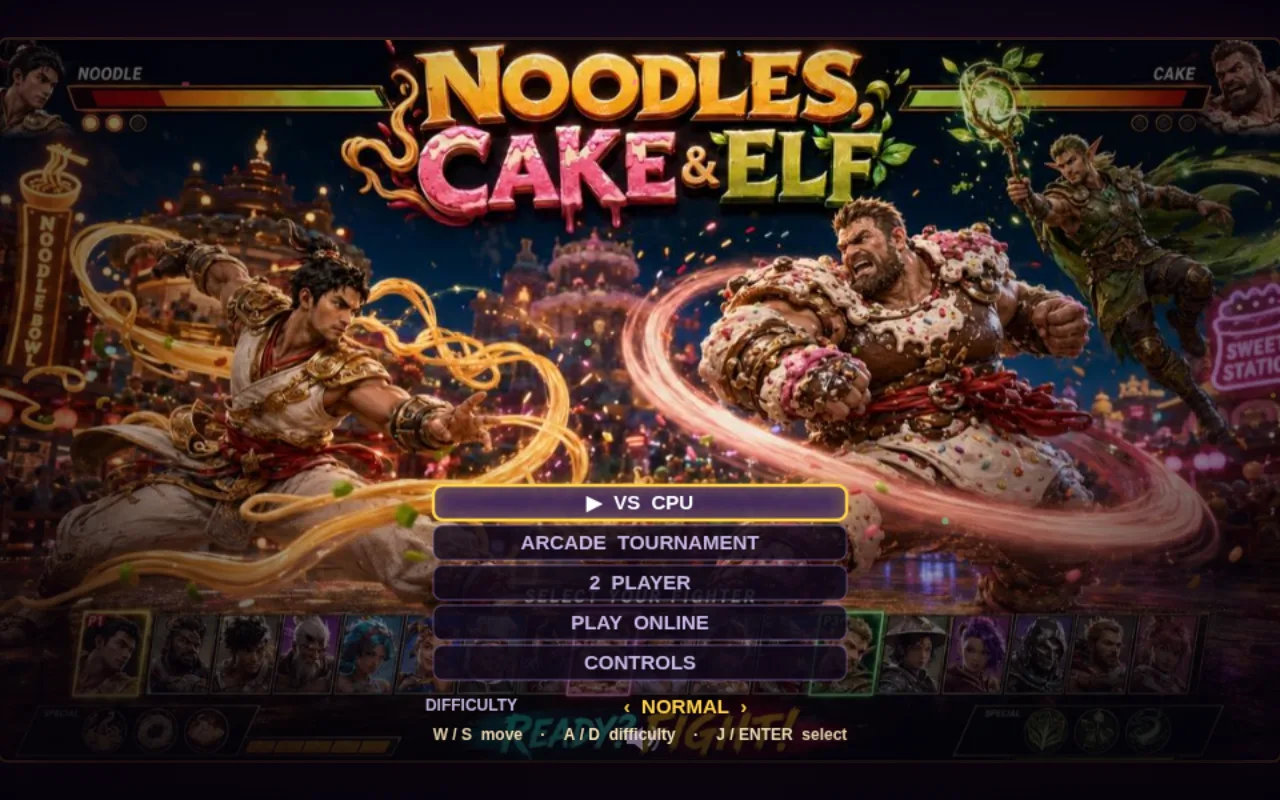
Every long-running friend group is secretly a fighting game roster. There is the one with the devastating put-down, the one who peaks too early on every night out, the one whose cooking is a group hazard, the two with a rivalry nobody else remembers the origin of. The taunts already exist. The signature moves already exist. The lore runs deeper than most published fighters.
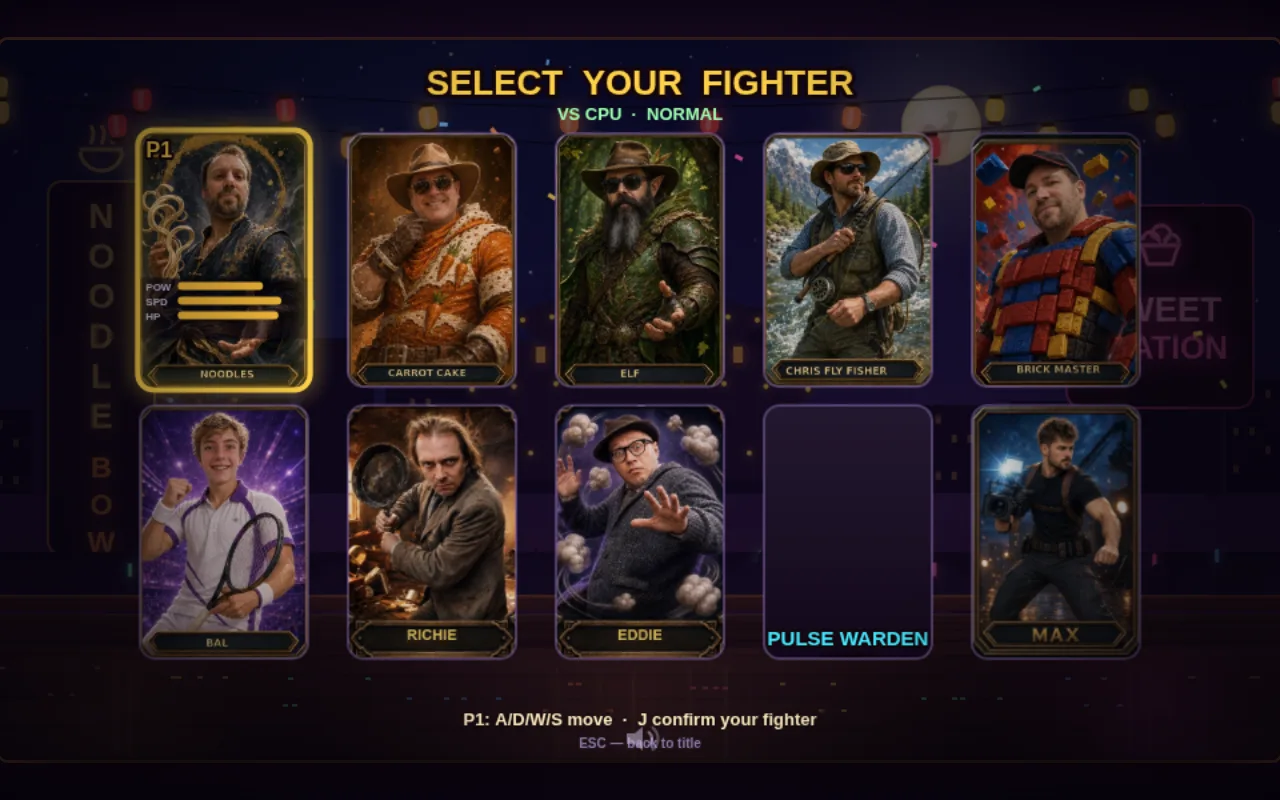
All of it is just waiting for someone to paint the character select screen.
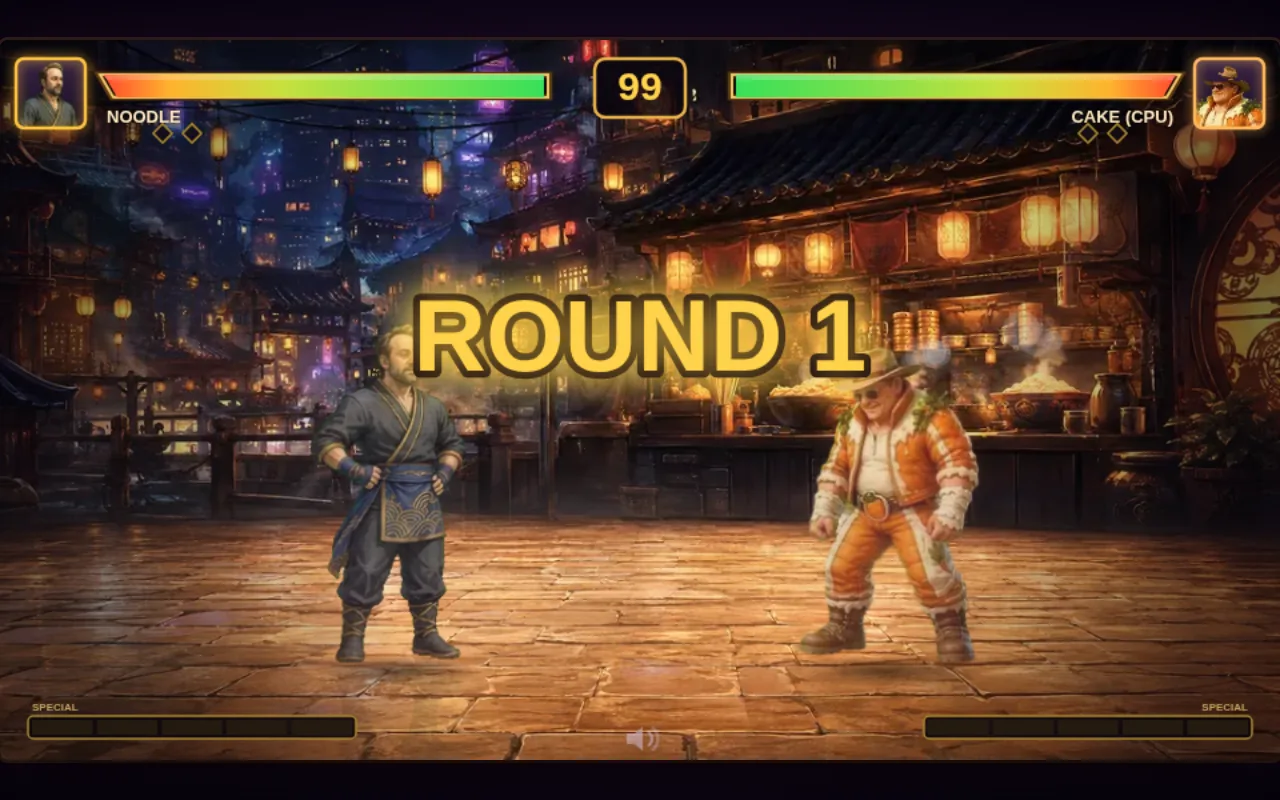
We know because we have built it. Noodles, Cake & Elf is a cinematic ten-character fighter where every combatant is a real person, hand-painted from photographs, with scripted taunts and a full arcade tournament mode. This is a guide to how a group chat becomes that game.
Why a fighter is the friend-group format
We build platformers, adventures and simulators too, and for couples and children they are usually right. For a friend group, the fighter wins for three structural reasons.
A roster is a cast of equals. A platformer has a hero and cameos. A fighter has ten headline slots, which is exactly the political arrangement a friend group requires. Nobody is a supporting character on the select screen.
The in-jokes become mechanics. In an adventure, a running joke is a line of dialogue. In a fighter it is a move, with a name, an animation and consequences. The friend who is always late gets a teleport that triggers slightly after it should. The one with the terrible car summons it, and it backfires. The joke stops being referenced and starts being playable.
It is built for a room. A fighter is two players and an audience, rotating. That is a party structure: winner stays on, losers heckle, the tournament bracket organises the whole evening without anyone having to host it.
What goes into the build
The roster. Every fighter painted by hand from photographs. Approval art comes first, so the group sees the painted versions before anything is animated. Fair warning from experience: the paintings are affectionately accurate, and the group will find them funnier than any caricature.
The moves and taunts. This is where the brief earns its keep. We ask for each person's reputation in the group: the catchphrases, the incidents, the thing they always do. It comes back as signature moves and scripted taunt lines delivered before each round.
The stages. The local. The flat where everything happened. The festival campsite. Painted as backdrops with the details the group will recognise instantly and nobody else will notice at all.
The tournament mode. At the top tier, a full arcade tournament structure with brackets, so the game can run an actual competitive evening rather than a sequence of exhibition matches.
The soundtrack. Original, scored to the build. Entrance themes are where the money is, musically speaking.
The practical shape
- 8-Bit, from £349: the compact version. Up to twelve painted characters across a smaller build, cutscenes and an original soundtrack. Right for a group where twelve covers everyone.
- 16-Bit, from £1,200: the full production. Unlimited painted characters, cinematic cutscenes throughout, and the arcade tournament mode. This is the tier our ten-character showcase fighter lives at, and it is the natural shape for the format.
- Delivery is a private web link on any phone or laptop. Nobody needs a console, which matters because every group contains at least three people who claim not to game and will then refuse to relinquish the phone.
- The group keeps it forever. Which is how it becomes an institution. The rematch demand starts about an hour after the first session.
Split across a group, the arithmetic is friendlier than it first looks: a 16-Bit fighter divided among ten people is the price of a good night out each. Our cost guide covers what moves a quote, and the process explains the stages and the approval art.
The occasions it gets commissioned for
The milestone birthday. One member turns thirty or forty and the group funds the game as the collective gift, with the birthday person painted as the headline fighter. It doubles as the party centrepiece: reveal at nine, bracket by ten.
The stag or hen weekend. The tournament slots into the weekend itinerary, and unlike almost everything else on a stag itinerary, it is rewatchable, legal and keeps. The groom as final boss is a well-established configuration, and it sits neatly inside a weekend built at home rather than abroad.
The reunion. The group that scattered across cities commissions the fighter for the annual gathering. Between reunions it lives in the chat, where the leaderboard argument never fully closes.
No occasion at all. A surprising number of these are commissioned simply because the group chat decided it should exist. That is a good enough reason.
What we actually need from the group
Less than most organisers expect, and none of it requires the group to know anything about games.
One photograph per fighter. Clear, well lit, face visible. A phone photo is fine. Group photos work if faces are distinct, but a single portrait each produces the better painting, and the worse the photograph, the more the character becomes an approximation.
A line or two per person. Their reputation in the group, stated plainly. "Always thirty minutes late." "Cannot be trusted near a barbecue." "Has argued about the same referee decision since 2014." That is genuinely the level of detail the moves come from.
The shared locations. The pub, the flat, the pitch, the campsite. A photograph of each if you have one, a description if you do not.
The occasion and the date. The schedule is agreed per commission rather than fixed, so the earlier we know the deadline, the more of the range is available to you.
Everything else is optional and everything else improves it. Nicknames, catchphrases, the incident nobody is allowed to mention, the running scoreboard on something trivial. Organisers routinely under-supply here on the assumption that the material is too specific to use. It is the opposite: the more specific it is, the less it could have belonged to anyone else.
Writing the brief without ruining friendships
The material is affectionate mockery, so calibration matters. Three rules that have served every group well.
One organiser, whole-group material. One person runs the commission, but quietly collects each member's greatest hits from the others. The best line about any given friend is never their own suggestion.
Tease the incident, not the wound. The failed driving tests, the disastrous barbecue, the haircut of 2016: in. Anything the person genuinely does not laugh about: out. The organiser knows the difference, and the approval stage exists as the safety net.
Everyone gets a good move. The mockery lands because every fighter is also, visibly, painted with care and given something genuinely excellent to do. The friend who cannot cook gets a flaming pan that is also the best move in the game. That balance is the tone.
The mistake to avoid
Waiting for the group to decide. Ten-person consensus is where good ideas go to die politely. These commissions happen because one person simply starts, collects the material, and presents the group with approval art instead of a question. Be that person; the group will forgive you the moment they see the select screen.
If the occasion attached is a wedding, the entertainment case covers how a game holds a reception. And if your group's shared history is specifically a gaming one, the nostalgia gift guide is aimed squarely at you.