Yes. It is the entire premise of a commission: somebody real, painted into a game, recognisable to the people who know them.
The questions worth asking are not whether it is possible. They are what a likeness actually consists of, and whose permission is involved.
How the likeness is made
Nothing from the photograph goes into the game. It is not cut out, filtered or traced.
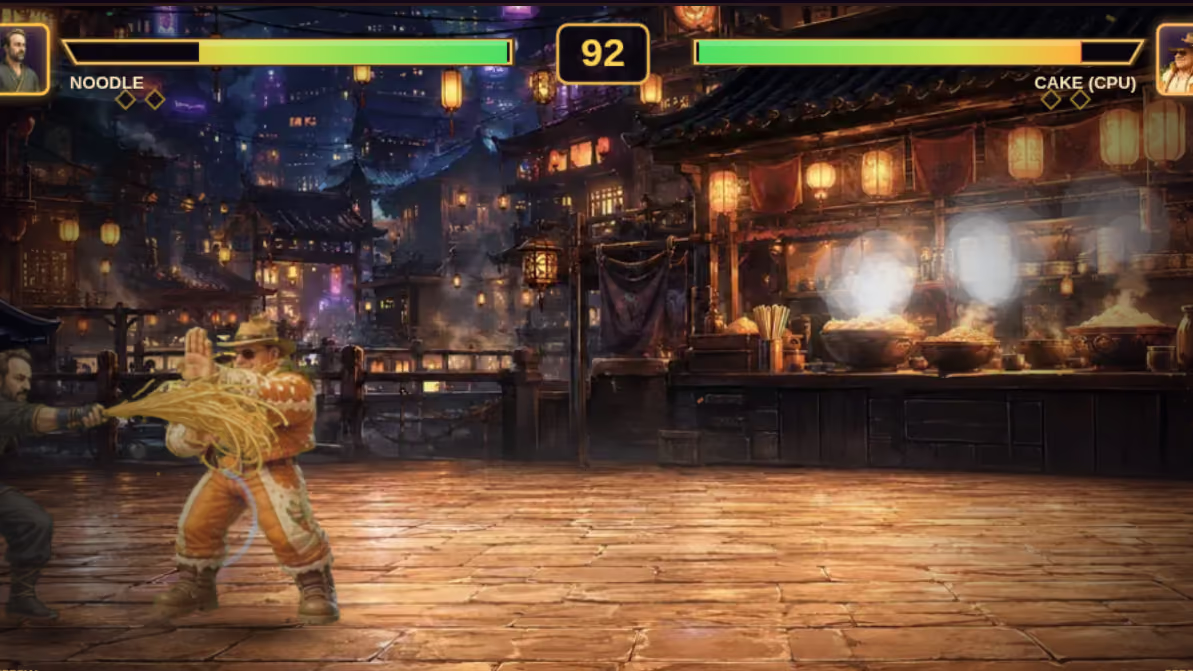
The character is painted fresh, in the style the rest of the game is in, at the size the game needs, in the poses it uses. That is the only way it sits alongside the backgrounds without looking like a photograph somebody pasted into a drawing.
Which means "will it look like them" is a slightly different question from what people expect. It will not be photographic. It will be a painted character that people who know them recognise immediately, in the way a good caricature is recognisable without being accurate.
What actually carries a likeness
This surprises people, and it changes what photographs are useful.
At the size a character appears on screen, a face is a handful of marks. What the eye recognises is the outline: how somebody stands, the shape of their hair, whether they are broad or narrow, and the one or two things they always wear.
A patterned jumper does more work than a nose. A particular way of standing is worth more than a clear photograph of a face.
The practical consequence is that a full-length casual photograph is far more useful than a studio portrait, which is set out properly in what photographs we actually need from you and how a photograph becomes a character.
It also means the likeness works better for some people than others. Somebody with a distinctive shape reads instantly. Somebody whose recognisability lives entirely in their face is harder, and we would rather say so at the brief stage than after the artwork exists.

Permission
The honest version, because this matters and it is easy to be vague about.
You need to be entitled to share the photographs. The commission form asks you to confirm this and it is a real question rather than a formality. For most commissions it is simple: your own photographs, of your own family.
For children, the person with parental responsibility decides. A parent sending photographs of their own child is straightforward. An aunt sending photographs of a niece should have the parents' agreement first.
For adults who are not you, ask them. There is no legal requirement in most private situations, and it is still the right thing to do, particularly for anything that will be seen beyond a small group.
For workplace commissions, ask individually. Not by announcement in a group channel, where declining is visible and therefore awkward. Individually, with a straightforward way to say no that requires no explanation. Somebody may have a reason they do not want to discuss.
If you would like to know what we do with the photographs once you have sent them, ask and we will tell you plainly.
Where the line is
Two things we will not do, and both are firm rather than negotiable.
Real people who have not agreed. That includes public figures, celebrities and anybody who has not consented to being in it. A game featuring a famous person as a joke is not something we will make, at any price.
Characters owned by somebody else. Recognisable characters, logos and trademarks from existing games, films and brands are not available to us, and putting them in a commission would create a problem for you as well as for us.
What is available is enormous by comparison: your family, your friends, your colleagues, your house, your street, your dog, your childhood bedroom. None of that belongs to anybody else and all of it is more interesting than a borrowed character.
People who have died
A common commission and one worth mentioning specifically, because people are often unsure whether to ask.
It is entirely possible and it is frequently the most affecting thing we build. Old photographs, faded prints, a single picture from decades ago: all usually workable, because posture and clothing survive damage well.
Say in the brief that this is what it is. It changes how the character is handled, what the tone of the writing around them should be, and whether the game should acknowledge it directly or simply have them present. Those are decisions worth making deliberately rather than by default.
How many people
Cast size is the main driver of cost, because every person is painted separately in every pose they need.
One person and a small supporting cast fits the single-level tier at £99. A proper cast, ten or more people, is a multi-level build at £349. A full studio production with the largest cast we offer is £1,200.
Worth knowing when deciding who is in it: each additional person is another household where the game gets opened, which is the strongest argument for a broader cast and is described in what makes somebody open a game twice.
What this means
Yes, and casual photographs work better than good ones.
Ask the people who will be in it, particularly at work.
Distinctive shapes read better than distinctive faces, so tell us what somebody always wears.
And nobody else's characters. Yours are better anyway.
The full process is in how commissioning a custom game works, and what to write is in how to write a brief for a custom game.