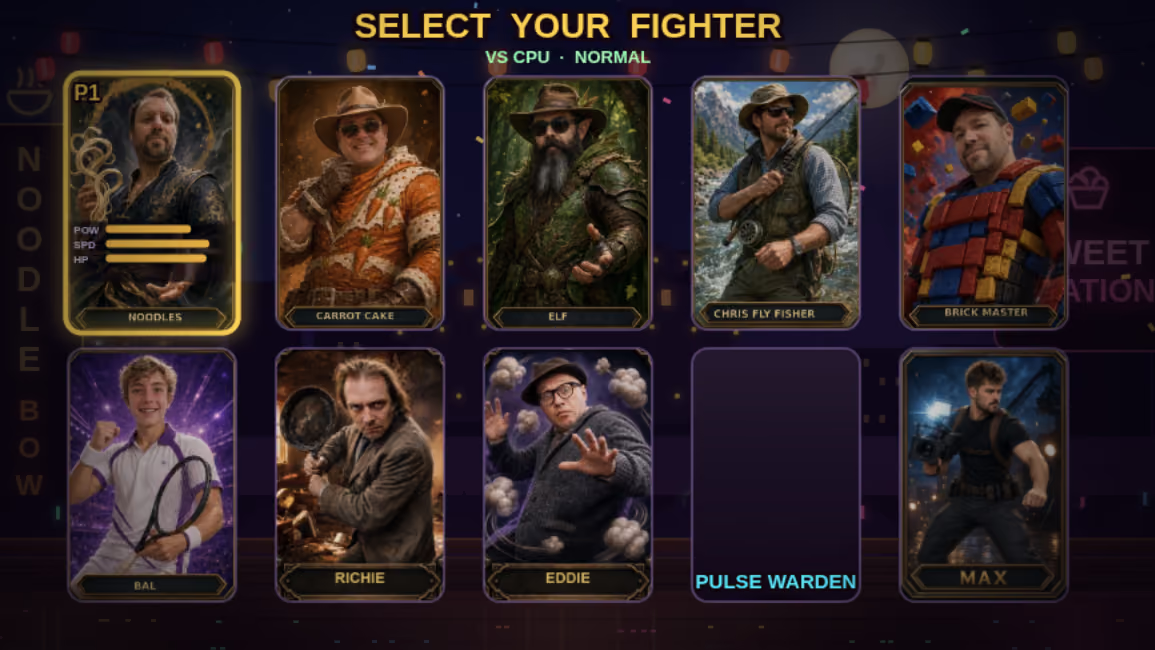
People assume the difficult part of putting a real person into a game is the likeness. It is not. A skilled illustrator gets a recognisable character out of one decent photograph in an afternoon.
The difficult part is everything the game then needs that photograph to do: stand on a floor, run, turn around, jump, be legible at a fifth of the size, and stay recognisably the same person through all of it.
The photograph is reference, not source
Nothing from the photograph ends up in the game. It is not cut out, filtered or traced. It is looked at.
The character is painted fresh, in the style the rest of the game is in, at the size the game needs, in the poses the game will use. That is the only way it can sit alongside the backgrounds and the other characters without looking like a photograph someone pasted into a drawing.
What actually carries a likeness is rarely the face, and this surprises people. At the size a character appears on screen, a face is a handful of marks. What the eye recognises is the silhouette: how someone stands, the shape of their hair, their build, whether they are wide or narrow, and the one or two things they are always wearing. A patterned jumper does more work than a nose.
Which is why the useful photograph is a full length one where the person is standing naturally, not a close-up of their face. A headshot gives you the least informative part of the person.
The silhouette test
There is a check worth doing on any game character, and it takes ten seconds: fill the whole thing in solid black and see whether you can still tell who it is.
If the answer is yes, it will read at any size, against any background, at any speed. If the answer is no, the character depends on internal detail that will disappear the moment it is small or moving, and it needs to be redrawn with more distinct outer edges.
This is why cartoon characters have exaggerated shapes and why game characters are often given a hat, a distinctive coat or a particular hairstyle. It is not stylistic preference, it is the silhouette doing the identifying.

Where the feet are
Here is the piece that is invisible until it is wrong.
A drawing is a rectangle of pixels. A character in a game is a thing standing on a floor. Those are not the same, and the bridge between them is an anchor point: a stored note saying which spot in this picture touches the ground.
In our platformer, every sprite carries its width, its height and a horizontal anchor as a fraction of its width. Drawing takes a position on the floor and works backwards from it: subtract the anchor to get the left edge, subtract the full height to get the top.
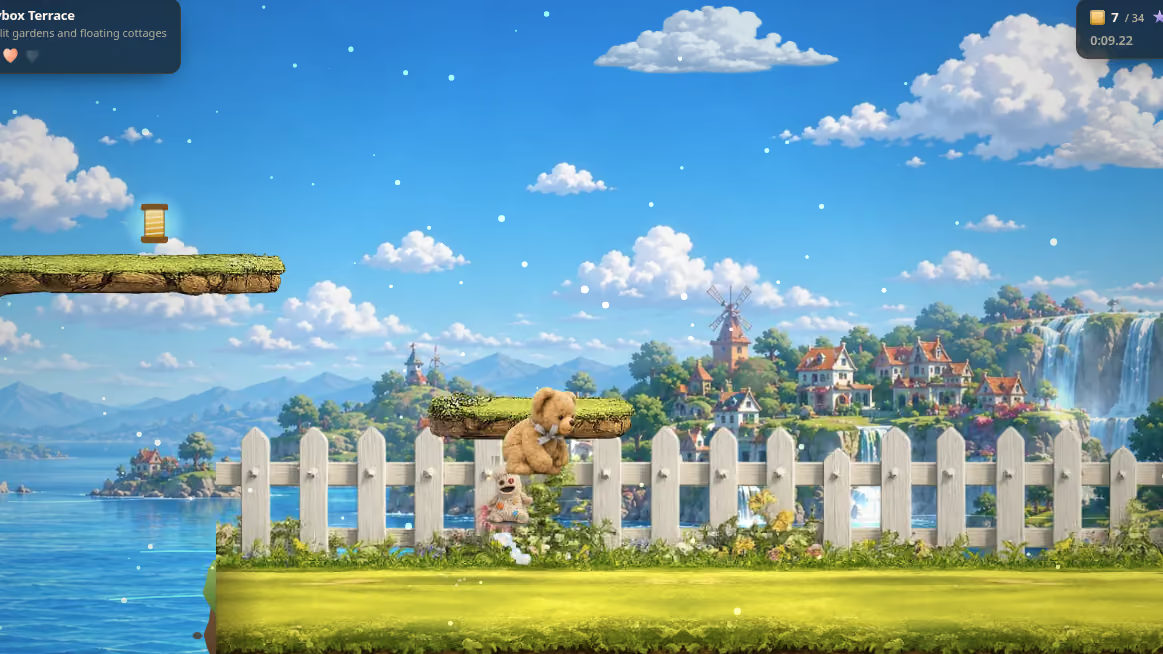
Without that, the game would align each pose by its top-left corner. A character with its arms raised is a taller picture, so aligning by the top means the feet move down and the character sinks through the floor for the duration of that pose. A jump pose with a bent leg is a shorter picture, so the character hovers.
Anchoring by the feet makes every pose sit correctly on the ground regardless of how much space the drawing takes up above it. It is one number per sprite and it is the difference between a character that is standing and a character that is floating.
Turning around is a mirror
When a character faces the other way, the sprite is not a second painting. It is the same painting drawn mirrored, which the game does by flipping the horizontal axis before it draws.
This halves the artwork for every pose, which at ten characters and several poses each is a very large saving. It also has one consequence that has to be decided deliberately rather than discovered: anything on one side of the character swaps sides when they turn.
A watch moves wrists. A bag moves shoulders. A parting flips. Most of the time nobody notices, and occasionally it matters enough that the pose needs painting twice. That is a per-character judgement made at the art stage, not something to find out about at the end.
Poses, not frames
A character does not need a film's worth of animation. It needs a small set of states the game can switch between.
Our engine template uses three: idle, walking and in the air. The draw code picks between them from state the physics has already decided. Not on the ground means the jump pose. Moving means the walk. Otherwise, idle.
That is the minimum that reads as alive, and it is genuinely enough for a great many games. Adding more is a scope decision with real cost: each additional pose is more artwork per character, multiplied by the number of characters. Going from three poses to six on a ten-character fighter is thirty extra paintings.
How those poses are cycled through, and why the timing of a walk must come from distance covered rather than from a clock, is a subject of its own in how to make a character walk without it looking wrong.
The fallback nobody sees
One last detail from our own code, because it says something about how these builds are put together.
If a sprite fails to load, the character is drawn as a plain rectangle and the game carries on being completely playable. Nothing errors, nothing hangs, the level can still be finished.
That exists because artwork arrives late in a commission, and the game has to be buildable and testable before it exists. It is the same separation described in why game artwork gets drawn twice: the picture is drawn over geometry that never knew what it was going to look like.
What this means for a commission
Send full length photos, well lit, natural pose. That is genuinely the whole brief for artwork. Everything else we can work with.
The likeness lives in the shape. If somebody is always in a particular jacket, say so. It will do more for recognition than any amount of detail on the face.
And more characters costs more than more levels. Every pose multiplies by every person. That is the single biggest lever on what an art budget looks like, and it is worth knowing before you decide the cast.