Every platformer we deliver runs the same engine. The rules of movement, the collision, the loop and the interface are shared code that does not change between commissions.
Saying that out loud is unusual, and it is worth saying because the alternative is a claim nobody can actually deliver, and because understanding it tells you where your money is going.
Why not build a new game each time
A genuinely novel game per customer cannot be produced reliably or repeatably at a price anybody would pay.
Not because it is impossible, but because new rules mean new bugs in the fundamentals, and bugs in the fundamentals are the expensive kind. Every commission would carry the risk that the jump does not feel right, that the collision has an edge case, that the game cannot actually be finished. Those are problems that take days to find and hours to fix, and they are unpredictable, which makes a fixed price and a fixed date impossible.
A shared engine has had those problems found already. The collision has been driven through hundreds of times. The jump has been tuned. The touch controls have been tested on a real phone, and the defect where the pads sat on top of the title screen buttons has been found and fixed once, permanently, for everyone.
What that buys is that a new commission starts from something that works, and the only thing that can go wrong is the part that is specific to it.
What the configuration actually holds
To be concrete rather than hand-waving about it.
At the top: the game's title, the introductory text, and a difficulty band, which is one of three words.
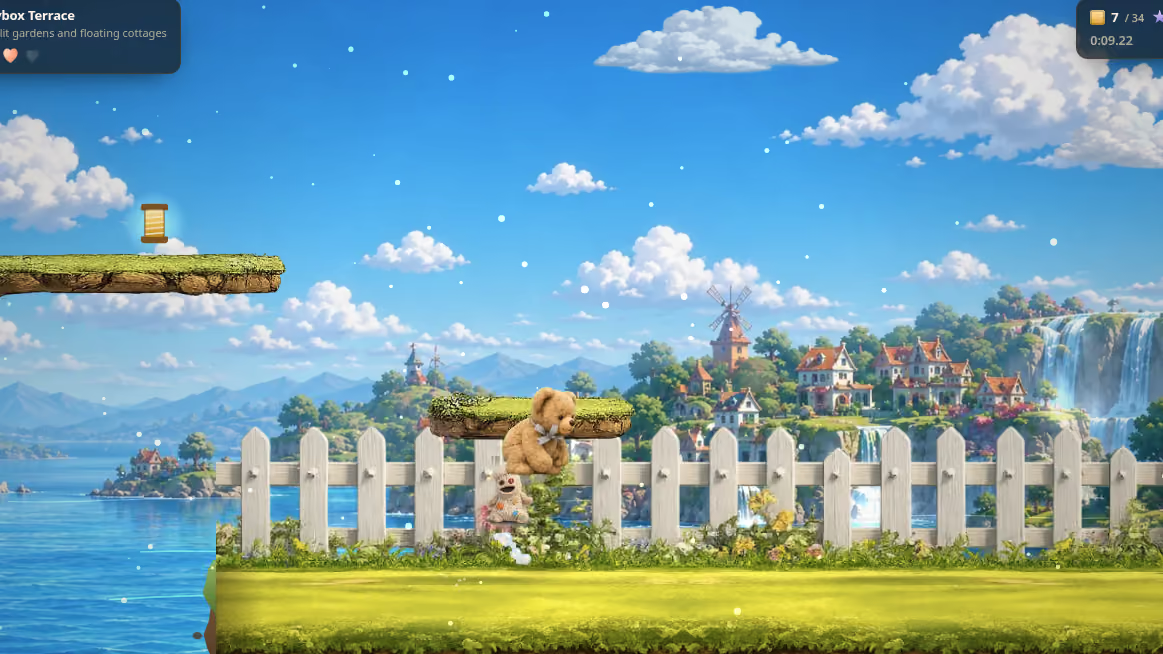
Then the character: a name, and artwork for standing, walking and being in the air. Three pictures.
Then the levels. Each one has a background image, a list of platforms as rectangles, a list of collectible positions, a start position, a goal rectangle and the strings shown on winning.
That is the whole description of a game. A build script reads it, encodes every asset, substitutes them into the engine template and writes out one self-contained HTML file, which is the delivery format described in putting an entire game in one file.

Difficulty is configuration too
One field is worth pulling out, because it does more than it looks.
The difficulty band is a single word and it selects a set of five numbers: gravity, jump strength, running speed, how long the forgiveness window after leaving a ledge lasts, and how many lives there are.
The gentlest band gives a floaty jump, a long forgiveness window and unlimited attempts, so there is no way to lose. The hardest gives a heavier fall, a much shorter window and three lives.
The same levels, the same artwork, three completely different experiences. That is what makes it possible to serve a four-year-old and an adult from one build, which is the subject of designing one game for a four year old and an adult and of does a game need a way to lose.
Where the bespoke work goes
This is the important part, because the reasonable question is what you are actually paying for.
The artwork. Every character painted from photographs of real people. Every background painted for this game. This is the largest part of the budget and it is entirely yours.
The level design. Where the platforms go, what is collectable, how hard each section is, how the first thirty seconds teaches somebody to play. That is design work per commission and it is where a game becomes about a specific place or memory.
The writing. The title, the intro, the level names, what appears when you win. The jokes only a particular family would get. This is a small number of words and it is disproportionately what people remember.
The tuning. Which difficulty band, whether the jump wants adjusting for this particular layout, how forgiving the landings are for this particular player.
None of those are shared. All of them are what somebody actually experiences. The engine is the part nobody notices, which is exactly what an engine should be.
The test that comes with it
A second benefit of a shared engine, and one that would be unaffordable per commission.
The engine exposes a small handle that lets a program press keys and advance the game a set number of steps without drawing anything. An acceptance test uses it to drive the character through the level with simulated input and assert that the goal can actually be reached.
That runs on every build. It means "the level is completable" is a verified fact rather than an assumption, and it is only practical because the interface it tests against is the same every time. The full argument is in proving a game is actually finished.
Where the engine stops
Being straight about the limits.
The shared platformer engine is a platformer. It cannot make a chess game, and our chess build shares nothing with it. It cannot make a point-and-click adventure across two continents, and our adventure build shares nothing with it either.
A brief that needs something the engine does not do is a different conversation with a different price, because it means writing new rules and taking on the risk that comes with them. Those exist and we have built them. They are not the same product, and pretending they are the same price would be dishonest.
What this means for a commission
Ask what is shared and what is not. Any studio should be able to answer that clearly. If they cannot, the answer is usually more shared than they are implying.
The engine being shared is why the date is real. It is the thing that removes the unpredictable risk from a fixed quote.
And it means the money goes where you would want it. Into the paintings of your family, not into rediscovering how gravity works.