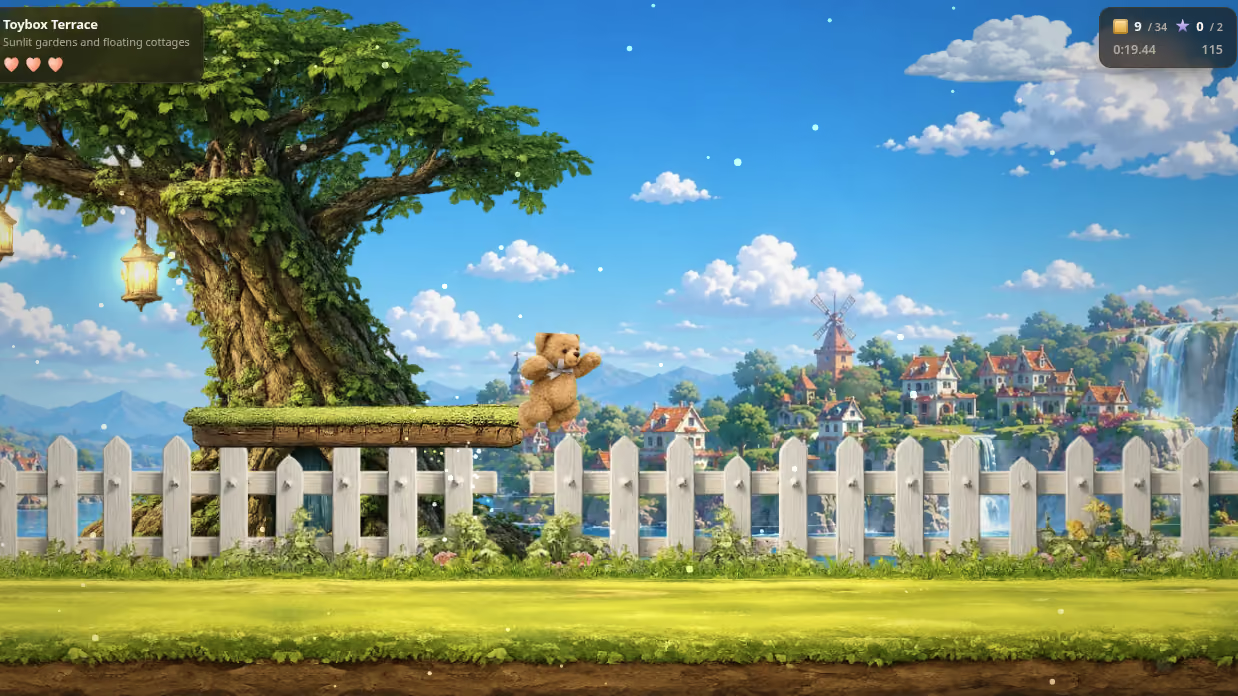
There is no way to lose our platformer at its gentlest setting. Fall off the bottom of the level and you reappear at the start of it. There are no lives, no game over, and no way to fail permanently.
That is not a watered-down version of the real game. It is a different answer to a real design question, and which answer is right depends entirely on who is holding the phone.
What failure is for
Failure is not there to punish. It is there to make success mean something.
A jump you cannot fail is not a jump, it is a corridor. The reason clearing a difficult gap feels good is that not clearing it was a live possibility right up until you did. Remove the possibility and you remove the feeling, and what is left is a walk through some scenery.
That is the case for failure and it is a strong one. Every tense moment in every game is built on the player believing something could go wrong.
What failure costs
The other side is equally real, and it is the side people building games tend to underweight because they are good at games.
Failure is discouraging in proportion to what it takes away. Losing thirty seconds is a setback. Losing ten minutes of progress is an insult, and a substantial number of people respond to it by not playing any more.
For a commissioned game that is close to fatal. The person receiving it did not choose to play a video game; they were given one. If it takes something away from them in the first two minutes, they will put it down, and there is no second chance because nobody plays a birthday present twice out of obligation.
And there is the particular case of a small child, where a game over screen is not a challenge, it is a rejection. A four-year-old who fails does not conclude that the jump was hard. They conclude that the game does not want them.
The middle answer: soft failure
Most of the value of failure comes from the setback, and most of the cost comes from what is confiscated. Those can be separated.
In our engine, falling off the bottom of the level puts the character back at the start of the level. Nothing is lost, no counter goes down, no screen appears. A few seconds, and a clear signal that what just happened was not the plan.
That teaches. The player understands that the gap was too wide, adjusts, and tries again with no reason to feel got at. It is the same lesson as losing a life, delivered without the discouragement, and for a great many games it is the whole answer.

One level, three tunings
The way our engine handles this is that failure is a setting rather than a structure.
Three named difficulties change five numbers between them: gravity, jump strength, running speed, how long the forgiveness window lasts after leaving a ledge, and how many lives there are. The gentlest gives a floatier jump, a longer forgiveness window and unlimited attempts. The hardest gives a heavier fall, a much shorter window and three lives.
The level does not change. The platforms are in the same places. What changes is how much room the player is given to be imprecise, and whether being imprecise eventually costs something.
That means one build can genuinely serve a child in the morning and an adult in the evening, without shipping two games. The full version of that argument is in designing one game for a four year old and an adult, and the forgiveness window itself is one of the mechanisms described in what makes a jump feel right.
Failure that is not about dying
Worth noting that "a way to lose" is broader than lives.
A timer creates tension without any possibility of permanent loss. A score creates a reason to replay without any failure at all. An opponent who can beat you, as in our chess build, provides the full weight of losing in a form nobody experiences as punishment, because losing at chess is normal and expected.
The chess game is a useful contrast precisely because it is all failure and nobody minds. You will lose to the harder difficulties. That is not discouraging, because it is what chess is, and because the game is careful to lose convincingly at the easier settings rather than simply playing badly. How that is done is in how a computer plays chess.
What this means for a commission
The question is who plays it and where. A game played once at a party wants to be finishable that evening. A game played at home over weeks can afford to be hard.
A game with no failure is not a lesser game. For a keepsake somebody walks through, looking at the places and people they recognise, tension would actively get in the way.
And it is a setting, so it can be both. Ask for a difficulty choice on the title screen if you are not sure. It costs almost nothing and removes the need to guess.