The usual explanation of parallax is a diagram of three layers sliding at different speeds, and it is accurate and it teaches you almost nothing about how to use it.
The useful question is not how parallax works. It is when a scene should get it, and what the alternatives are, because a game full of parallax looks as wrong as a game with none.
Our painted adventure decides this per room, and the decision is written into the level data as one of three modes.
The problem, stated properly
You have a painting. It is a single image of a street, a station concourse, a park. You have a character who needs to walk around inside it.
The character is not in the painting. The painting has no idea the character exists. So something has to reconcile a flat picture with a body that moves, and there are only so many ways to do it.
The naive approach is to draw the character on top and let them walk left and right until they reach the edge. It works, and it makes every scene feel like a diorama in a shoebox: a small stage with a photograph at the back.
Mode one: direct
The first mode is to accept the diorama and make it deliberate.
The painting fills the screen and barely moves. The character walks across a floor the painting already contains: the tiles of a station, the flagstones of a courtyard, the boards of a room. There is no separate foreground, because there does not need to be one. The picture is complete.
This is right for interiors and for anywhere intimate and enclosed. A room is a room. It has walls you can see all of, and pretending otherwise by sliding it around would be worse than leaving it still.
The trade is that the scene is exactly as wide as the painting, so it is a short scene. That is usually fine, because a room should be a short scene.
Mode two: parallax
The second mode is the one this article is named after, and its job in our game is not depth. It is length.
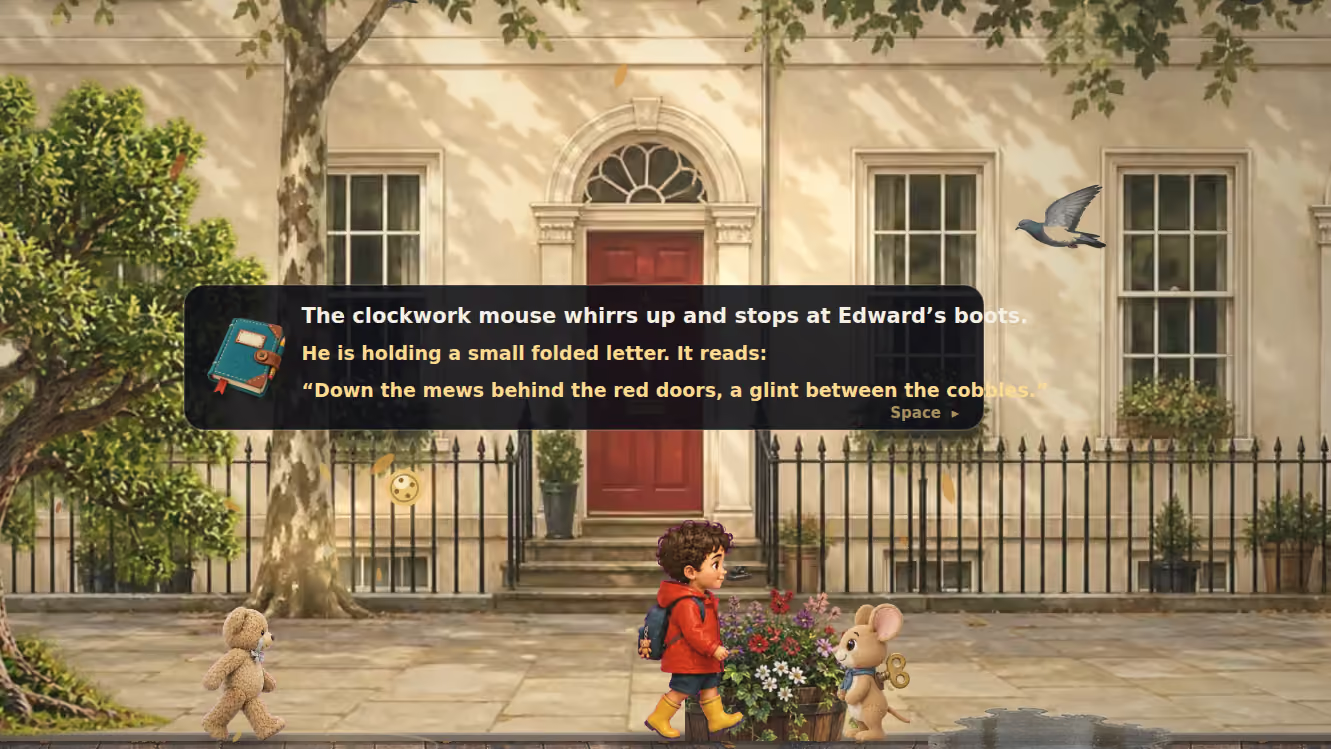
The painting sits back and drifts slowly. In front of it runs a consistent foreground: pavement, kerb, railings, a low wall. That foreground moves at full speed and, crucially, it repeats.
Because the foreground repeats, the scene can be any length at all. The character can walk for as long as the story needs, with the painting drifting behind and the pavement running past in front, and the whole thing was produced from one painting and one strip of foreground.
The depth comes free. Two speeds is all the eye needs to decide there is space between the near thing and the far thing. But the reason to reach for it is that it extends a scene without inventing artwork that does not exist. The comment in our own level data puts it exactly that way: this is how a scene gets extended without inventing anything.
That is the honest version of parallax in a hand-painted game. It is a technique for making a finite amount of artwork go further, and the depth is a very welcome side effect.

Mode three: depth
The third mode exists because some paintings are not views and are not rooms. They are scenes with a specific walkable region that has an awkward shape.
A canal lock where the only standing ground is a stone quay on the right, and the middle of the picture is a chamber full of water. A fountain fenced off across the full width, where walking forward would mean walking through railings. A boathouse that is almost entirely water, with a towpath in front.
For these, the room carries a small set of numbers describing where the floor actually is: the near and far edges of the walkable band, and how the character scales between them. The character walks into and out of the scene rather than only across it, getting smaller as they go back, and the floor is shaped to the painting rather than assumed.
This is the most work per scene and it is used sparingly, on the rooms where the alternative was to cut the painting or to let a bear walk on water.
Why it is a per-room field
All three modes live in the same level data, and each room names the one it uses. Some rooms carry a short comment saying why, written at the time by whoever made the call: the lock, because the middle is water; the boathouse, because there is nothing to stand on; the fountain, because it is fenced across its whole width.
That is the actual craft. Not knowing what parallax is, which takes five minutes, but looking at each painting and deciding what kind of space it is. A game that applies one answer everywhere reads as mechanical, and players feel it without being able to name it.
It also means the artwork can be judged on its own terms. A painting does not have to be produced to fit a system; the system is chosen to suit the painting. That is the opposite of how most engines work, and it is only affordable because the scenes are hand-painted in the first place, which is a large part of why that build is 20MB.
What this means for a commission
Parallax is a budget technique before it is a beauty technique. It buys length from artwork you already have. That is why it appears where a journey needs to feel long and not in a room that only needs to feel like a room.
The foreground is the expensive half. It has to be produced separately, it has to tile without a visible seam, and it has to sit believably in front of every painting it is used with. That constrains the palette of the whole chapter.
And it is a scope conversation, not a style one. How many distinct scenes a game has is the single biggest driver of what it costs to make. The full build this comes from is described in how we built a painted London adventure, and how a character is made to move convincingly across these scenes is in how to make a character walk without it looking wrong.