A walk cycle can be two drawings. It can also be twenty-four. The difference in how it looks is much smaller than you would expect, and the difference in what it costs across a cast of ten is enormous.
Knowing where the returns fall off is one of the more useful things to understand before agreeing an art budget.
The four poses a walk is made of
Traditional animation breaks a stride into four positions, and every walk cycle you have ever seen is built from them.
Contact. Both feet on the ground, furthest apart, at the moment the leading heel lands.
Down. The weight transfers onto the leading leg and the body is at its lowest point in the whole cycle.
Passing. The back leg swings through past the standing leg. The body is at its highest, pushed up by the straightened supporting leg.
Up. The push-off, before the next contact.
A full stride is those four, then the same four mirrored for the other leg. So eight frames is a complete cycle with every pose drawn. Four frames is the same cycle mirrored, which works for most characters and fails for anyone visibly asymmetric.
Two frames
Two frames is the minimum and it genuinely works.
Take the contact pose and its mirror. Alternate between them. What the eye receives is feet swapping positions at a walking rhythm, and it fills in everything between without being asked. This is the same effect that makes a flick book with six pages read as motion.
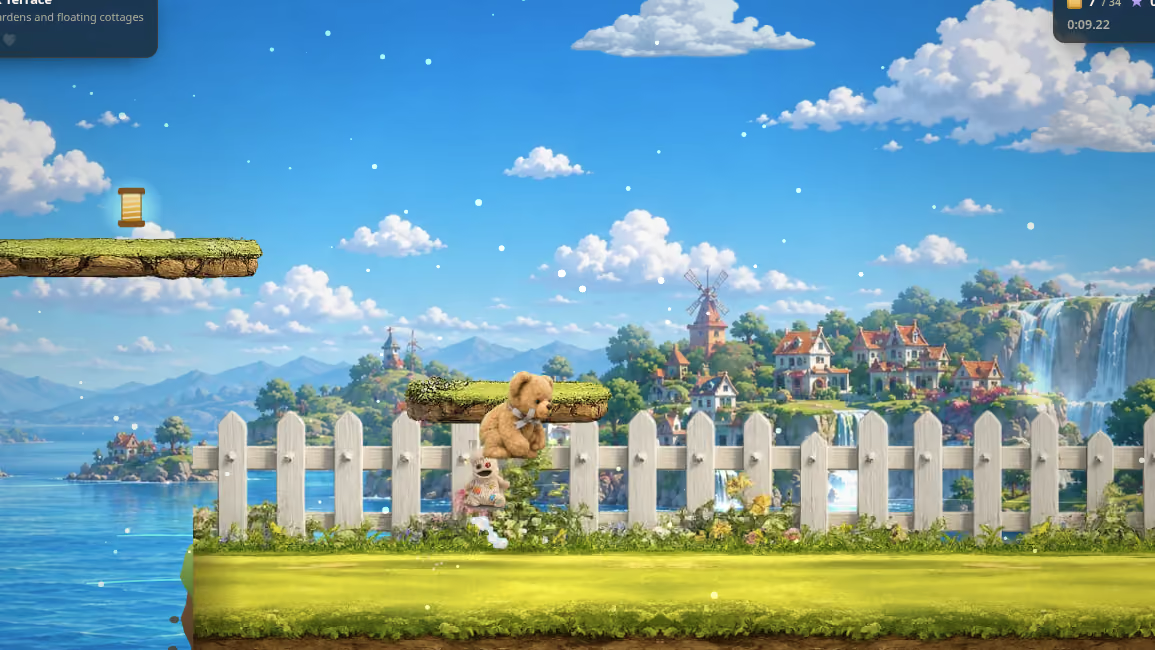
It looks like a game from 1983, which may be precisely what you want. Our engine template does something close to this: it holds one walking pose and switches to it whenever the character is moving, which is the one-frame version, and at the size and speed the character moves it reads perfectly well as walking.
Where two frames falls down is anywhere the character is large on screen, slow, or being looked at. A close-up two-frame walk looks like a puppet.
Four frames
Four is the point at which a walk stops being a signal and starts being animation.
Contact, down, passing, up, mirrored. The body now rises and falls, which is the single biggest improvement, because the vertical bob is what the eye reads as weight. A character that stays at a constant height while its legs move looks like it is on wheels.
For almost every commissioned game, four is the right answer. It is a fourfold increase in artwork over one pose and it buys most of the available quality.

Eight and beyond
Eight frames gives a fully drawn cycle with no mirroring, so an asymmetric character works, and the in-betweens smooth the motion further.
It is noticeably better if you are looking for it. Most players are not, because at the size a game character occupies while moving across a screen the difference between four and eight is a few pixels of leg position for a sixtieth of a second.
Beyond eight, at these sizes, the returns are close to nil. Feature animation uses twenty-four frames a second because it is shown at cinema scale and held on for seconds at a time. A game character crossing a screen is neither.
The multiplication problem
Here is where this becomes a budget conversation rather than an aesthetic one.
Frames do not cost once. They cost per pose, per character. A ten-character fighting game going from four frames to eight for one action is forty extra drawings. Do it for three actions and it is a hundred and twenty, which for most commissions is more artwork than the rest of the game contains.
Set against that: forty drawings is also an entire additional level, or four new painted locations, or two more characters in the cast. For a game that somebody is being given, a cousin who was left out is felt far more keenly than a slightly smoother walk that nobody will ever consciously notice.
That is almost always the right trade, and it is worth making explicitly rather than by accident.
Frames are not the hard part
The genuinely important thing about a walk cycle is not how many drawings it has. It is what advances them.
If the cycle is advanced on a timer, the feet slide. A character that speeds up keeps stepping at the same rate and skates across the floor, and everyone sees it even if they cannot name it.
If the cycle is advanced by distance covered, the feet stay planted. Walk slowly and the animation is slow. Run and it is fast. Change speed mid-stride and it tracks correctly, with no extra work and no tuning.
That single decision does more for how a character reads than doubling the frame count, and it is free. It is the subject of how to make a character walk without it looking wrong, and it is the first thing to get right.
What this means for a commission
Four frames, and spend the rest elsewhere. That is the recommendation in almost every case.
Ask what the character is doing, not how smooth it is. A character that can walk, jump and celebrate is worth more than one that can only walk beautifully.
And check the timing before adding frames. A two-frame walk driven by distance looks better than an eight-frame walk driven by a clock, which is a genuinely counterintuitive result and the reason it is worth knowing.