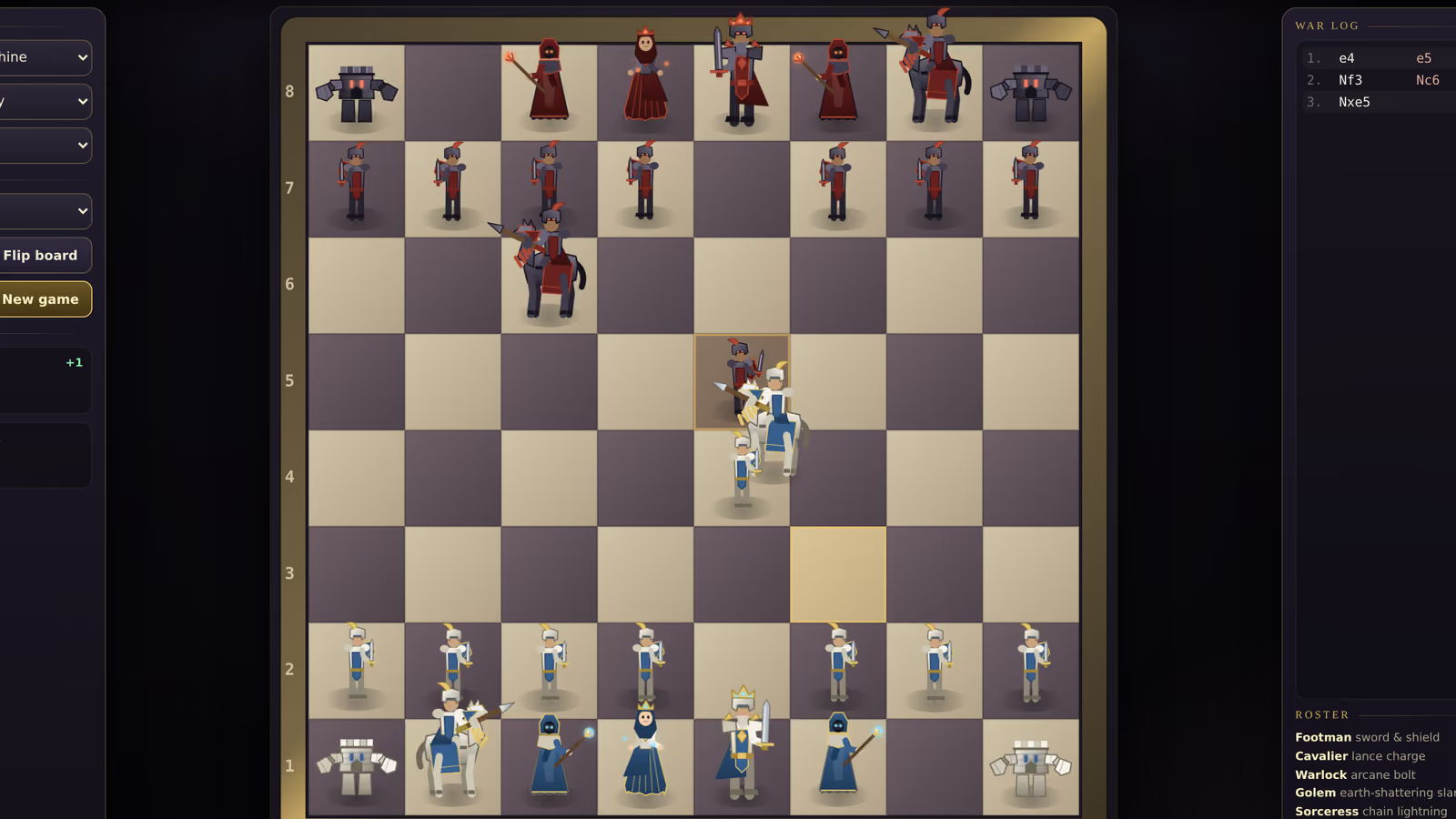
In our chess game, taking a piece is not a piece disappearing. The two of them fight, and the fight has to land as a real event rather than as a cartoon, on a board that is otherwise entirely still.
Nothing in a game ever actually collides. An impact is a stack of separate, individually trivial effects, fired in the right order, and it is one of the clearest examples of how much of game feel is theatre.
The stack
Our effects system carries five things and an impact uses most of them at once.
Particles, thrown from the point of contact. Not in every direction: a burst can be given a direction and a spread, so a lance strike throws sparks along the line of the blow while an explosion throws them everywhere. Each particle gets a randomised speed, size, lifetime and gravity, and picks its colour from a small set, which is what stops twenty identical dots looking like a pattern.
A ring, expanding outward from the impact point and fading as it grows. This is the single most underrated effect in games. It is a circle. It costs nothing. And it does more to communicate "something happened here" than any amount of particle work, because it draws the eye to an exact location.
Screen shake, which moves the entire drawing surface by a small random offset for a few frames, decaying quickly. Nothing on the board has moved; the view has. The eye reads that as the world being jolted, which implies force that nothing else in the frame could convey.
A flash, a single moment of full-screen colour at low opacity. It is closer to a flicker than a flash. It reads as the moment of contact.
Bolts and slashes for specific attacks: a line drawn between two points with jitter along its length for chain lightning, an arc for a blade.
Individually every one of these is a first-week exercise. Together, in the right order, they are an impact.
The order matters
They do not fire simultaneously.
Flash first, on the exact frame of contact, and gone almost immediately. Then particles and ring together. Then the shake, which outlasts both. Then the reaction: the struck piece falls, the square clears.
Getting that sequence wrong makes a hit feel soft in a way that is very hard to diagnose. A shake that starts before the flash reads as an earthquake that a hit happened during. A ring that appears after the particles reads as a separate event.

The pause is the trick
The most effective impact technique costs the least and is the one people miss: stop everything for a moment.
A few hundredths of a second where nothing moves, at the instant of contact, before the reaction plays. The struck character is frozen mid-recoil, the attacker frozen mid-swing, and then it all resumes.
The effect on perceived force is dramatic and completely out of proportion to what is happening, which is nothing at all. It works because it is what your eye does with a real impact: it fixes on the moment. It also gives the player a fraction of a second to register what has occurred, which matters when several things are happening.
It scales, too. A small hit gets a very short pause, a decisive one gets longer, and that difference alone communicates significance without any additional artwork.
Make it optional
Here is the part that separates an effect that is enjoyed from one that is endured.
Our chess build offers four settings for combat: cinematic, normal, swift, and off entirely. Off means captures resolve instantly, exactly as they would in ordinary chess.
That exists because the value of an animation is inversely proportional to how many times you have seen it. The first capture is a delight. The fortieth, in a game you are trying to win, is an obstacle between you and your next move. Somebody playing seriously wants it gone, and a game that will not let them turn it off is a game they stop playing.
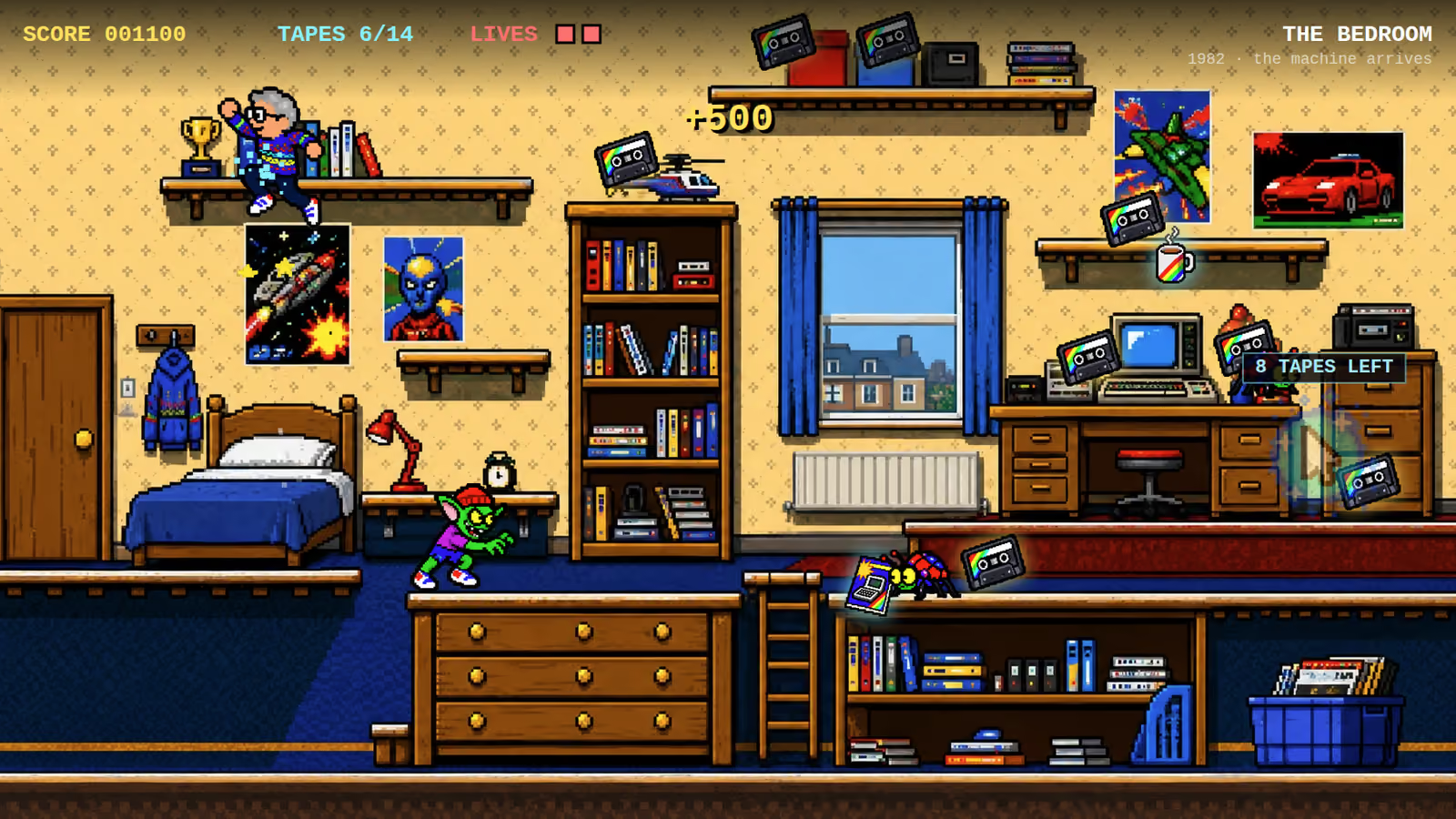
The general principle is that anything which repeats and takes time should be skippable. That includes cutscenes, level transitions and loading theatre. Our tape loading screen offers the same escape hatch for the same reason, as described in how we built a cassette loading screen.
Sound is half of it
An impact with no sound is not an impact, and this is worth saying because it is easy to tune the visuals in silence and wonder why they feel weak.
The sound does something the visuals cannot: it has no travel time and no ambiguity. A sharp attack at the exact frame of contact tells the ear precisely when the hit landed, and the eye then agrees with it.
Both of our builds generate these rather than playing files. A rising sequence of notes for winning, a falling one for losing, a low tone with noise over it for something heavy. No recordings, and the technique is set out in how a game makes sound without any sound files.
Tune it shorter
The one consistent lesson from tuning these is that the first version is always too long.
The reason is structural. Whoever is tuning the effect is watching the effect. They trigger it, look at it, adjust it, trigger it again. In that mode a longer effect is a better effect, because there is more to look at.
The player is not watching it. They are playing, and the effect is between them and their next decision. Almost every impact effect improves when it is cut to half the length that felt right in isolation, which is a finding that only shows up when somebody else plays it, as in what one person watching can tell you.
What this means for a commission
Impact effects are cheap and high value. They are code, not artwork, so they do not multiply across a cast the way animation frames do.
They should be skippable. Anything a player sees forty times needs an off switch.
And they are where a game stops feeling like a prototype. A build with correct mechanics and no feedback plays fine and feels flat, and the gap between those two is a few days rather than a few weeks.
The build is playable in the arcade. Try it on cinematic first, then turn battles off and see how much is lost.